

What’s the ROI of Social Media?

Many small businesses may wonder what is the return on investment (ROI) of social media for their bottom line. That’s a valid question.
Over the past few years, I’ve talked to numerous business owners, marketing directors, and operations managers, and some ask, “Why should we be active on Facebook, Twitter, Instagram, TikTok (or any social platform)?” This question indicates they are looking for the connection between social media activity and more customers.
An increasing number of companies understand that social media is an important part of a comprehensive marketing program in the 2020s. Though, I’d like to present some compelling information that makes a solid case for being active on social media.
This article will look at the cold hard data, how many people are using social media, and how social media can help elevate your brand and help your SEO. We’ll also look at which platforms have the most active users, and what type of content works best on each platform.
Why Do Companies Invest in Social Media?
That’s the question smaller businesses should ask themselves. Why do larger companies post so much content on social media?
The answer is a very simple one.
Large, national, and international companies are always looking to find new customers, with as little friction and customer acquisition cost (CAC) as possible. Social media is a place where most of their customers already spend time, energy, and focus. Therefore, reaching those future customers, and building brand awareness is fundamental to their overall marketing strategy.
An oft-repeated idiom in marketing is that prospects need to see an ad, or hear a company’s name and pitch between 7 and 21 times before they go further down the marketing funnel, and eventually make a purchase. This is the whole “they must know, like, and trust you before they buy from you” saying that you may have already heard.
Social media is a way to reach prospective customers where they already spend time. This is why global brands spend time and resources creating social media content and extending their reach.
The History of Social Media and SEO
When I first started building websites and doing SEO for side projects, circa 2011 to 2013, there was a lot of chatter in the SEO world that Facebook shares and likes had an effect on SEO. This belief was so prevalent that many SEO tools of that era would track how many Facebook shares web pages had received. I remember hearing rumors that Google had a deal with Facebook to access an unfettered firehose of user data, possibly used for indexing purposes.
However, as early as 2013, it appeared that Facebook was no longer allowing Google unrestricted access to that data, as they were busy building their own version of a knowledge graph, to make connections between entities. My theory is that Google, if they ever used popularity of a web page shared on social media as a metric for SEO rankings, never considered it again after those events. This is pure conjecture on my part, based on popular beliefs at the time.
To be fair, Google may have never even considered using likes, shares, or metrics from any of the social networks, as those signals can be very noisy, and quite easily manipulated by using fake accounts. About eight to ten years ago, there was a whole side industry in the SEO space, providing inflated shares, thumbs up, and views of articles on various social platforms.
The direct influence of shares, likes, retweets, and other social vanity metrics seems to have no effect on SEO rankings today.
In fact, a 2013 study by Eric Enge determined empirically that Facebook likes and shares seemed to have no effect at all on rankings. Noisy signals are poor signals.
There is still speculation today that Google has some sort of working arrangement with Pinterest, and possibly Twitter, as content from these platforms seems to get indexed fairly quickly. But again, that has never been confirmed, and is more of a theory that some SEOs believe than an established fact.
What Google Might Look For With Social Media
Putting aside conjecture, there’s an even more direct connection between social media presence and SEO. Back in 2008, then CEO of Google, Eric Schmidt told a room full of advertising professionals that brands are a solution to the cesspool of sorting millions of pages and ranking them algorithmically. He said, “Brands are the solution, not the problem…brands are how you sort out the cesspool.”. He said that on one side of the sorting were the large brands that had earned public trust, and on the other side was everyone else.
In other words, Google has always been looking for ways to measure how powerful a brand is, and actively looks for characteristics of a large brand.
One way that Google might recognize a brand is how many links it receives from websites that have a high degree of public trust. Mentions of the brand name may also be a clue. But, one thing that global brands do that many one-person businesses fail to do, is claiming, maintaining, and actively posting and engaging on branded social media profiles, that are linked from their main website, that also link back to that central website.
This is one reason we advise setting up social profiles for your company on the most prominent social media platforms (whatever those are, when you are reading this).
But an even more interesting phenomenon is how social media apps became such an integral part of our daily lives.
Why Social Media Grew Exponentially
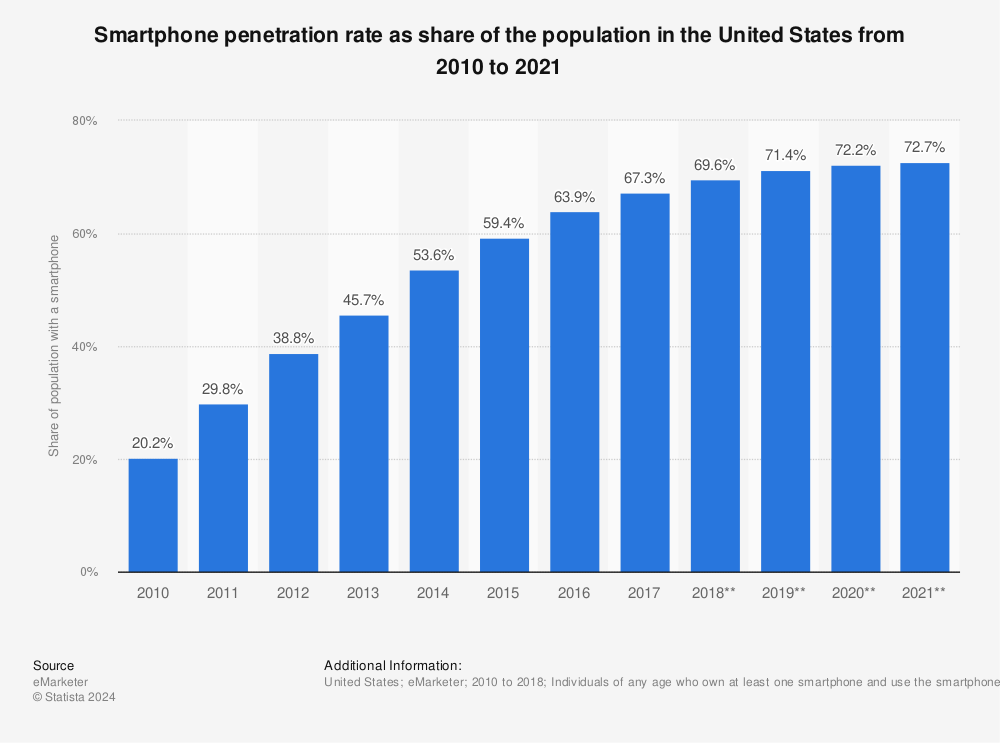
The rise of social media, and the proliferation of numerous platforms, coincides directly with the ubiquity of the smartphone, both domestically, and worldwide.
Find more statistics at Statista
Data from Statista shows that smartphone penetration in the US rose from 38.8% in 2012 to a staggering 72.7% by 2021.
The global smartphone penetration rate reached an even higher rate of 78% by 2020. This means that in 2020, over 6.4 billion people had access to a smartphone.
Perhaps not coincidentally, this decade is when many social networks began to flourish, and many users began using more than a single social platform as their main digital touchpoint. In the Web 2.0 days of the early 2000s to the early 2010s, there seemed to always be one social platform that dominated the rest. In the US, those were Friendster, MySpace, then Facebook.
Today in 2022, we have no less than four social networks with over a billion monthly average users (this isn’t even counting WhatsApp and Messenger, both owned by Meta, which each have over a billion users.) In addition to that, there are seven to ten social platforms heavily used in the US with at least 100 million monthly active users.
Monthly Average Users of the Top Social Platforms
Here are the monthly average users of some of the most important social platforms in the US, in 2022.
- Facebook – 2.910 billion
- YouTube – 2.562 billion
- Instagram – 1.478 billion
- TikTok – 1 billion
- Snapchat – 557 million
- Pinterest – 444 million
- Twitter – 436 million
- LinkedIn – 310 million
- Twitch – 140 million
Monthly average users numbers from Statista, for January 2022, Information retrieved December 2022; except Twitch and LinkedIn user numbers from Demandsage, for March 2022, retrieved December 2022.
Social Media Profiles in the Knowledge Graph
For SEO purposes, our belief is that you should prioritize social platforms that are eligible to appear in Google’s public-facing Knowledge Graph for your company. These are currently:
- YouTube
- TikTok
- Tumblr
- Soundcloud (for music artists)
- Myspace (for music artists)
Content Formats of Selected Social Media Platforms
Here are some of the forms of content that are commonly shared on each social platform.
| Social Platform | Text Content | Images | Videos | Audio | Live Streaming |
|---|---|---|---|---|---|
| Yes | Yes | Yes | Yes, as embeds | Yes | |
| Yes, limit 280 characters per tweet | Yes | Yes, as embeds or live video | Yes, as embeds in tweets | Yes, audio via Spaces; video via Share Live. | |
| Yes | Yes | Yes | As embeds | No | |
| YouTube | Yes, as Community Posts. Must have 500 subscribers to use this feature. | Yes, in Community Posts only. | Yes | Yes, if uploaded as MP4 or other video format | Yes, if no copyright strikes or channel restrictions in last 90 days. |
| TikTok | As overlays on videos | No | Yes | No | No |
| Accompanying images only | Yes | Yes | No | No | |
| Accompanying Pins only | Yes | Yes | Yes | No | |
| Snapchat | Some | Yes | Yes | Some | No |
| Twitch | Live chat only | No | Yes | No | Yes |
Quick Notes on Selected Social Media Platforms
Facebook: The largest social network started to see it’s first decline in monthly active users in Q4 2021. Increasingly shunned by younger users. Still used by many middle age and older users daily.
Twitter: Went through an ownership change in late 2022, many changes are happening currently. Has inspired a wide array of social apps with competing functionality, but for now, remains one of the main players.
LinkedIn: Owned by Microsoft since 2016. LinkedIn is focused on business networking, professional content is more the norm here. Post content on a LinkedIn Company page to get in front of C-level executives, corporate influencers, and decision makers.
YouTube: Not the original video sharing platform, but by far the most successful one. Owned by Google (subsequently holding company Alphabet) since 2006. Videos can be shared via links or embeds in many other social network posts.
TikTok: Fastest growing social network of the 2020s thus far. The short video format was copied by YouTube to create their “Shorts” feature. Videos stay on user timelines.
Instagram: Acquired by Facebook (now Meta) in 2012. Started as image sharing, has evolved to sharing videos as part of user “Stories” which are also visible on Facebook to followers there. “Posts” are static in user Timelines.
Pinterest: “Pins” are visual bookmarks of web pages, videos, images, and other hyperlinked sites in a user’s collection. These collections are often sorted into different categories.
Snapchat: Stories are viewable by public or subscribers for 24 hours before disappearing. The “stories” format was copied by Instagram directly from Snapchat. Content is made to be ephemeral on this platform.
Twitch: This platform is built around live streaming, and is used extensively by gamers and streamers. Some global brands have a presence on Twitch. The user base tends to skew younger than other platforms.
Making the Case for Social Media
For the company with a small marketing department, or even a business still getting off the ground, this information may be overwhelming. How do you decide where to spend your time and resources on social media?
My suggestion is to, at the least, establish a branded profile on these platforms: Facebook Page, Twitter, YouTube, LinkedIn Company Page, TikTok, and Instagram. Try and keep the username consistent across all these platforms, if possible. People should be able to find you on each platform quickly.
Where do you believe your ideal customers spend time? Perhaps your customer avatar hangs out on Facebook and LinkedIn. Maybe they are on YouTube and Twitter. Possibly, they are watching videos on TikTok. You can post some content on all your platforms, and by measuring engagement, you can determine where your time and resources are best invested. (For the record, we get our best returns from YouTube, Twitter, ad LinkedIn, in that order. Your results may vary.)
Be sure to link to your social profiles on your website, and then link back to your website from each of your branded social profiles. This helps Google figure out that these social profiles are all an extension and representation of your brand.
Schema Data and Social Profiles
If you have a website built on WordPress, many SEO plugins have a setting for outputting Schema structured data to show that your social profiles are extensions of your brand, with your website as the central hub. If you’re curious whether your website is outputting this data, you can use the Schema Markup Validator to check. Properly formatted sameAs Schema data should show up under the Organization link.

Get Involved on Social Media
Social media has it’s place in your overall marketing plan. Your customers, and Google, expect to see you there. Finding the best platforms from which to acquire more customers requires some experimentation, but with persistence, you can establish a sold presence on social, and even cultivate some true fans of your company and your brand.
If you still have questions about SEO or how social media helps support organic search rankings, feel free to reach out and contact us, we’ll be happy to help you make sense of your digital marketing strategy.


